
TGAM Articles
Responsive Dreams 2026 converts Granollers into a laboratory of art created with code
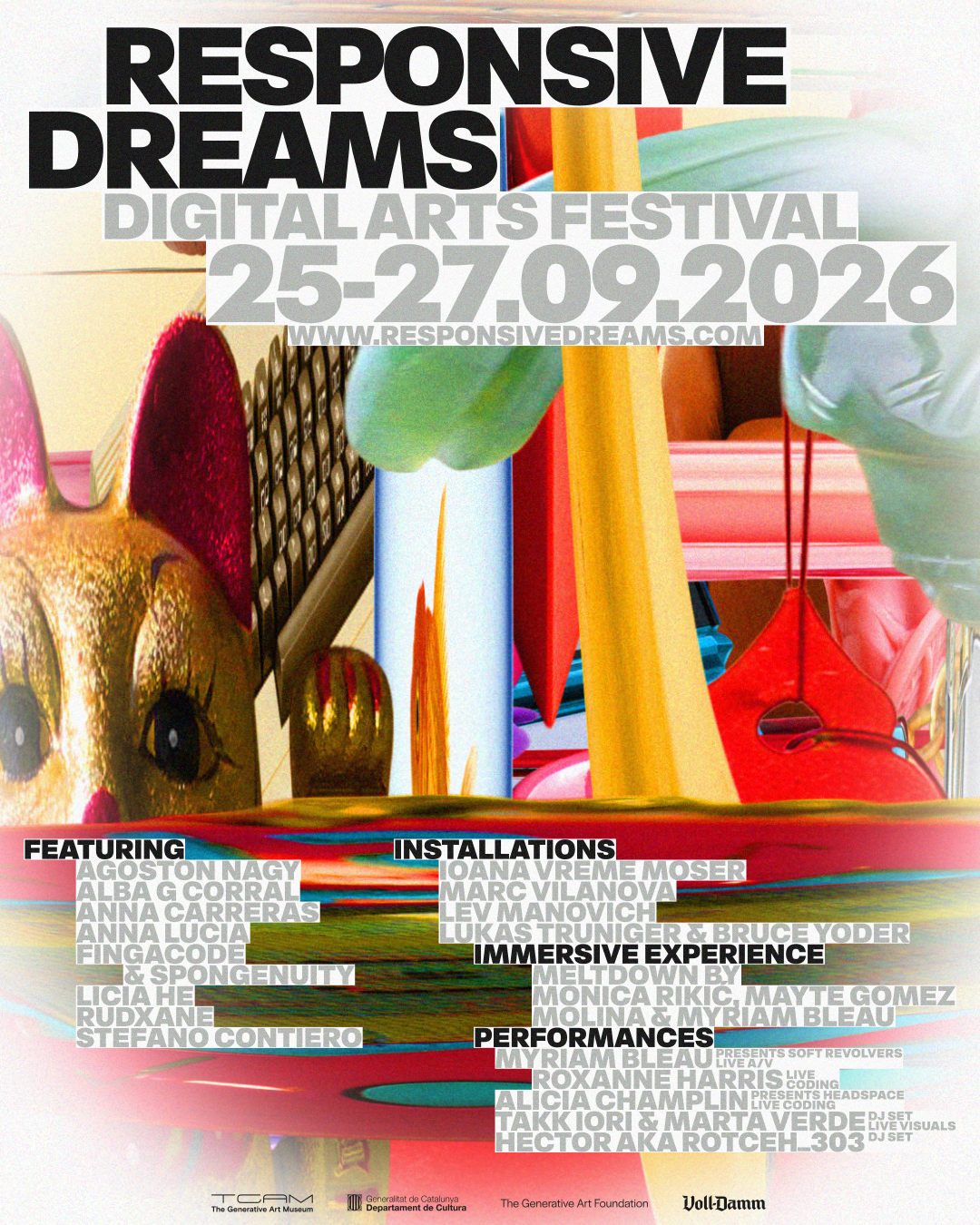
Promoted by The Generative Art Museum (TGAM), Responsive Dreams brings together works that are not limited to being shown on screen: they evolve, react, behave autonomously, and open up new ways of imagining digital creation. Over three days, the festival will present Dream Projects —long-duration generative pieces created specifically for this edition—, installations, audiovisual performances, artist presentations, a panel discussion, and activities open to the public.
The 2026 edition proposes a journey through algorithmic landscapes, visual systems in constant transformation, experimental electronics, sound, sculpture, data, robots, and digital narratives. The program brings together local and international artists with practices that cross research, programming, music, moving images, and installation.
Dream Projects
Dream Projects are long-duration generative works conceived to inhabit the exhibition space and transform continuously.
Anna Carreras — Idoni An infinite animation constructed from geometric layers, particles, and digital collage processes. Anna Carreras is a generative artist and creative coder; her work explores the balance between order, chance, and emergent behaviors through algorithms written from scratch.
Alba G. Corral — Flora A digital garden of particles, curves, and fractal explosions evoking organic shapes in transformation. Alba G. Corral is a visual artist and creative programmer, recognized for her generative landscapes and improvised audiovisual performances.
Agoston Nagy — Semantic Noise An unstable audiovisual interface where text, symbols, glitches, and digital structures form incomplete narratives. Agoston Nagy is an artist, researcher, and educator investigating the crossroads between algorithmic systems, intuitive thought, sound, and technology.
fingacode & Spongenuity — sketch01_final_FINALv1_final A collaborative piece that converts the language, errors, revisions, and imagery of a code repository into generative visual matter. Fingacode is a Cameroonian artist based in the UK working with interaction, image, and sound; Spongenuity explores color, algorithmic portraiture, and the relationship between data, chance, and physical media.
Licia He — Yarntificial City A virtual knitted city inhabited by creatures built from pixels, threads, and grids. Licia He is a generative artist and human-computer interaction researcher; she combines algorithms, robotics, and physical systems to transform code into visual and emotional narratives.
rudxane — tabellen A series that uses numbers, characters, and repeated units as visual material, shifting data from its informative function toward composition. Rudxane is a visual artist from Amsterdam active in computer art since the 1990s, interested in introducing human gestures and qualities into generative systems.
Stefano Contiero — Effimero A reflection on the transient that combines generative animation and physical drawing on sand performed by a pen plotter. Stefano Contiero is an Italo-Dominican artist with a practice connecting generative systems, memory, identity, and emotional states.
Installations
The installations expand the festival's language into the physical, sonic, and spatial realms.
Anna Carreras — Caniques A generative installation in which each pixel behaves like a marble or a person: it observes its surroundings, makes decisions, and forms unpredictable groupings.
Lukas Truniger & Bruce Yoder — Implausible Rainbows A work connecting synthetic natures, infrastructures, and material phenomena. Lukas Truniger is a visual artist, electronic composer, and creative technologist; Bruce Yoder is a scientific researcher and collaborator on the artistic project Ethereal Fleeting, focused on the delicate balances between science, matter, and perception.
Ioana Vreme Moser — Perikon Smelters An installation of experimental electronics, matter, components, and sound that puts the histories of technology and its production chains under tension. Ioana Vreme Moser is a Romanian sound artist based in Berlin, known for her deliberately fragile and tactile electronic processes.
Marc Vilanova — Phonos A proposal inviting listeners to hear what usually remains outside the center of our attention. Marc Vilanova is a sound and visual artist; his work lies between art, science, nature, and technology.
Lev Manovich — Soft Cinema II An installation extending Manovich's investigation into software, visual culture, and the ways data and digital media construct new narratives. Lev Manovich is an artist, author, and one of the most influential theorists of contemporary digital culture; he directs the Cultural Analytics Lab at The Graduate Center, CUNY.
Additionally, the festival will host meltdown, an immersive installation by Mónica Rikić, Mayte Gómez Molina, and Myriam Bleau that poses an experience around loss, technology, and affective relationships with smart devices.
Performances
Alicia Champlin — Headspace A performance addressing listening, perception, and collective creation from sound and bodily experience. Alicia Champlin is an artist, researcher, and Deep Listening® facilitator, with a practice situated between participatory performance, improvisation, and systems.
Roxanne Harris — Syntax::stream A live coding performance where code becomes an instrument and improvisation occurs in real-time. Roxanne Harris is an artist, musician-programmer, and researcher; her work explores computing as a space for gesture, memory, sound, and collective thought.
Myriam Bleau — Soft Revolvers An audiovisual performance articulating light, sound, movement, and custom-designed technologies. Myriam Bleau is a composer and digital artist based in Montreal, internationally recognized for her critical works on innovation and its imaginaries.
meltdown: Immersive experience
During Responsive Dreams, visitors will also be able to visit meltdown, a new immersive installation by artists Mónica Rikić, Mayte Gómez Molina, and Myriam Bleau, curated by Xavier Hernández and promoted by The Generative Art Museum (TGAM), with the support of Roca Umbert Fàbrica de les Arts.
The proposal starts from a question: how would we experience the loss of a smart technological device that decided to consciously abandon us? And, above all, what part of our identity would disappear with it?
Conceived as a video game brought into the physical world, meltdown invites the public to step into an immersive, playful, and walkable experience. Through various decisions and forms of interaction, visitors will discover a universe built with projections, screens, sound, sensors, handcrafted robotics, and interactive systems. Each decision transforms the experience and raises new forms of relationships between people and technology.
The installation reflects on the increasingly intrusive presence of devices and algorithms in our daily lives, and their influence on our decisions and identity construction. meltdown proposes imagining other ways of relating to technology based on dialogue, personal agency, and building more conscious bonds.
The installation opens on Saturday, September 12 at 7:00 PM in Sala Zero of Espai d’Arts at Roca Umbert Fàbrica de les Arts, in Granollers, and can be visited until September 27: Fridays, from 5:00 PM to 8:00 PM; Saturdays, from 11:00 AM to 2:00 PM and from 5:00 PM to 8:00 PM; and Sundays, from 11:00 AM to 2:00 PM.
To experience it, you must leave your mobile phone outside: a way to disconnect from our devices and connect with what happens inside the installation —touching, listening, observing, and playing.
Creative Coding Barcelona: technology, art, and institutions
As part of the fourth edition of Responsive Dreams, Creative Coding Barcelona is organizing a panel discussion bringing together artists and thinkers with extensive backgrounds in code-based art, technology, and new media practices.
Technology is part of our daily lives and how we understand the world. Nevertheless, it is still surprising to see it in museums. Why are technological languages still often treated as an exception? What language can speak better of the present than the very one building it?
The conversation will feature Lev Manovich, Mónica Rikić, Ioana Vreme Moser, Lukas Truniger, and Marc Vilanova, addressing how these practices are produced, exhibited, and perceived across different contexts. It will also bring to light necessary changes for institutions, exhibition spaces, and critical discourses to adapt to works that can behave, fail, connect, or require maintenance.
Technology is not an artistic genre or an anomaly needing justification: it is a tool, a material, and an extension of our ability to imagine, construct, and question the world. It is time to leave behind the "digital art" label as a separate compartment and stop asking ourselves if this is art.
It is art.
The program is completed with an audiovisual set by Takk Iori and live visuals by Marta Verde, alongside artist presentations and screenings from previous editions.
Responsive Dreams 2026 September 25–27, 2026 Nau Dents de Serra, Roca Umbert Fàbrica de les Arts Granollers, Barcelona
More information and press kit materials: responsivedreams.com/press-kit
An infinite animation constructed from geometric layers, particles, and digital collage processes. Anna Carreras is a generative artist and creative coder; her work explores the balance between order, chance, and emergent behaviors through algorithms written from scratch.
Published: 2026-09-01
Author:
The Generative Art Museum