
TGAM Articles
Live coding: the art of sharing
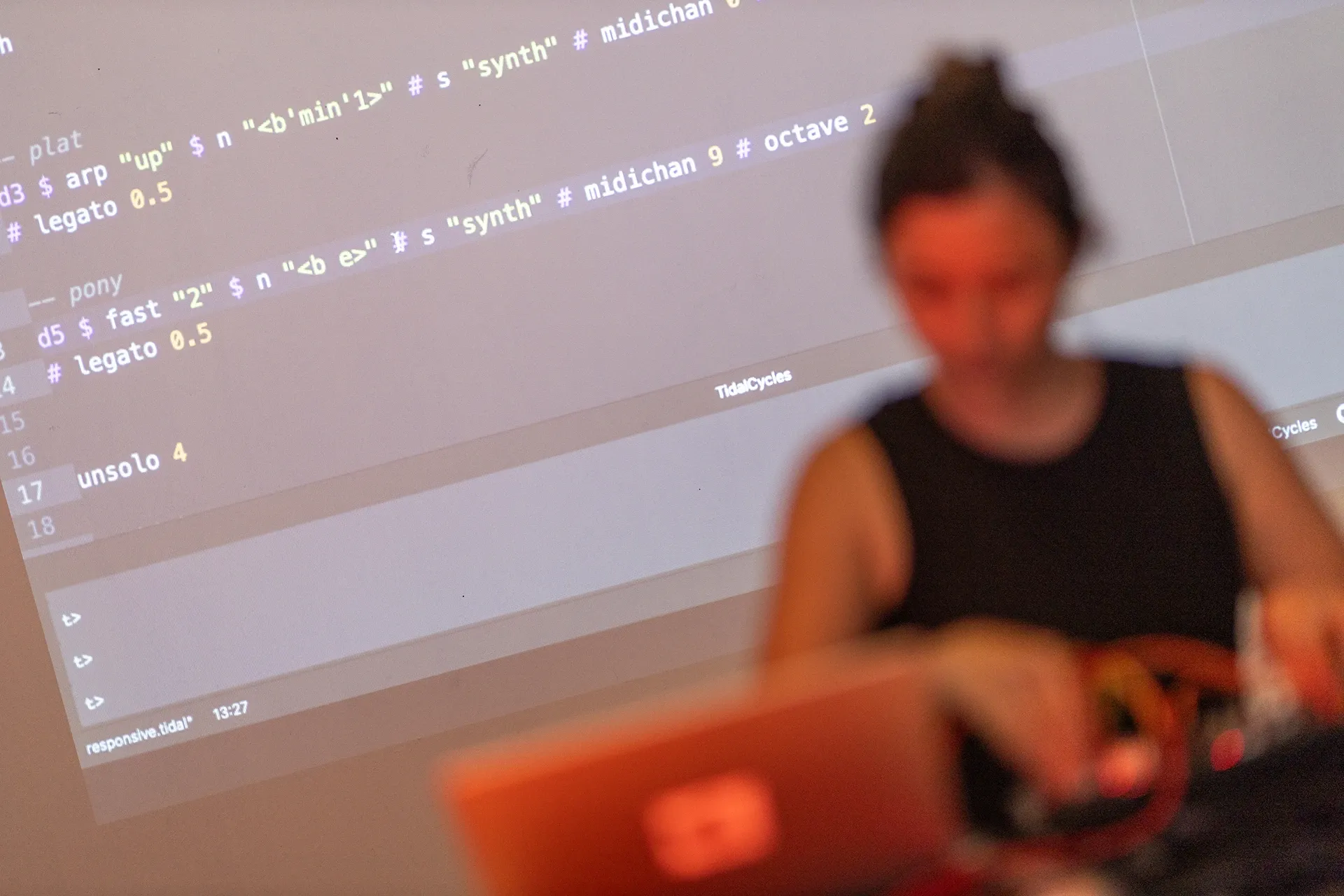
Linalab at Responsive Dreams 2023 – Photo: Jordi Muntal
In 2004, in Hamburg, a group of artists and programmers founded TOPLAP (Temporary Organisation for the Promotion of Live Algorithm Programming), a community that still defines the rhythm of this culture. Its manifesto defended ideas as radical as they were necessary: code should be visible, experimentation constant, and the creative process transparent. From that hacker and collaborative spirit, a global scene was born.
Since then, live coding has spread to cities around the world. There are festivals and gatherings in London, Mexico City, Berlin, Buenos Aires, and Barcelona, where local communities organize under the umbrella of TOPLAP. Specific languages and environments such as TidalCycles, Sonic Pi, and Hydra have also emerged, further democratizing this practice.
Today, live coding is much more than a technique: it’s an open community that blends art, science, and critical thought. It’s a space where one can dance to a techno set generated by code, enjoy psychedelic visuals written in three lines of text, or debate the role of technology in society.
One of the most significant events in this context is the International Conference on Live Coding (ICLC), which this year took place in Barcelona thanks to TOPLAP Barcelona, the Axolot collective, and the Open University of Catalonia (UOC). The event brought together artists, researchers, and technologists in a program of performances, workshops, and lectures around the concept of liveness and its multiple forms.
Beyond the program itself, the gathering reflected the essence of the live coder community: open, inclusive, transversal, queer, and radically beautiful. A collective that shares knowledge transparently and makes available to everyone the tools and research that make this artistic practice possible.
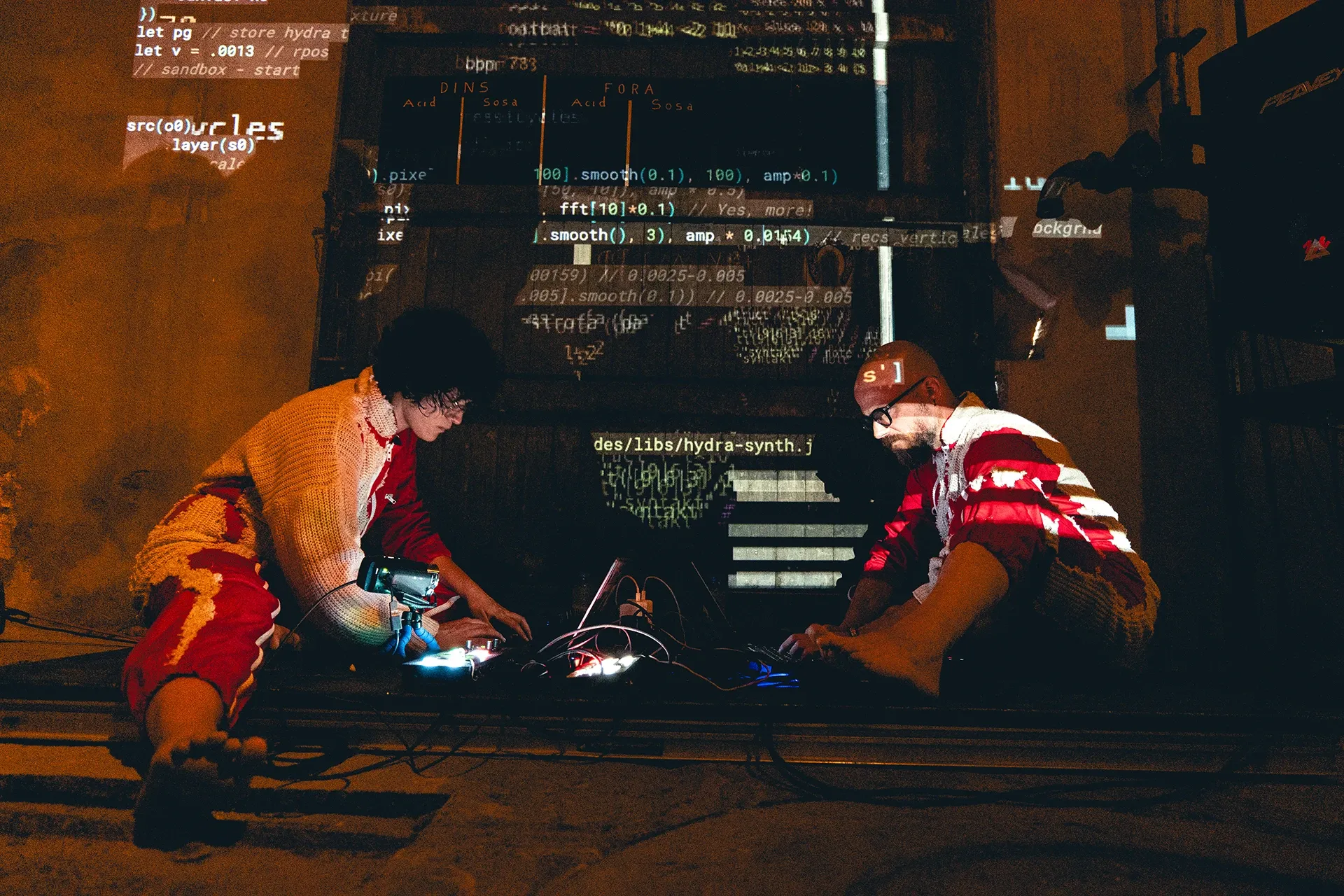
Turbulente (Citlali Hernández) and Eloi El Bon Noi at RUSF Series – Photo: Yose Llobet
Now, the arrival of artificial intelligence opens a new horizon. Far from replacing the artist, it invites us to imagine codes that improvise, artificial agents that respond in real time, and new scenarios where creativity is shared between humans and machines. It’s a fertile ground that raises questions about authorship, control, and emerging aesthetics.
Within the digital creative scene, live coding holds a unique place: it’s at once performance, experiment, and laboratory. It prioritizes process over result, turning programming into a performative act that can be danced to, watched, and shared. In doing so, it becomes a meeting point between electronic music, visual art, technological research, and critical thinking.
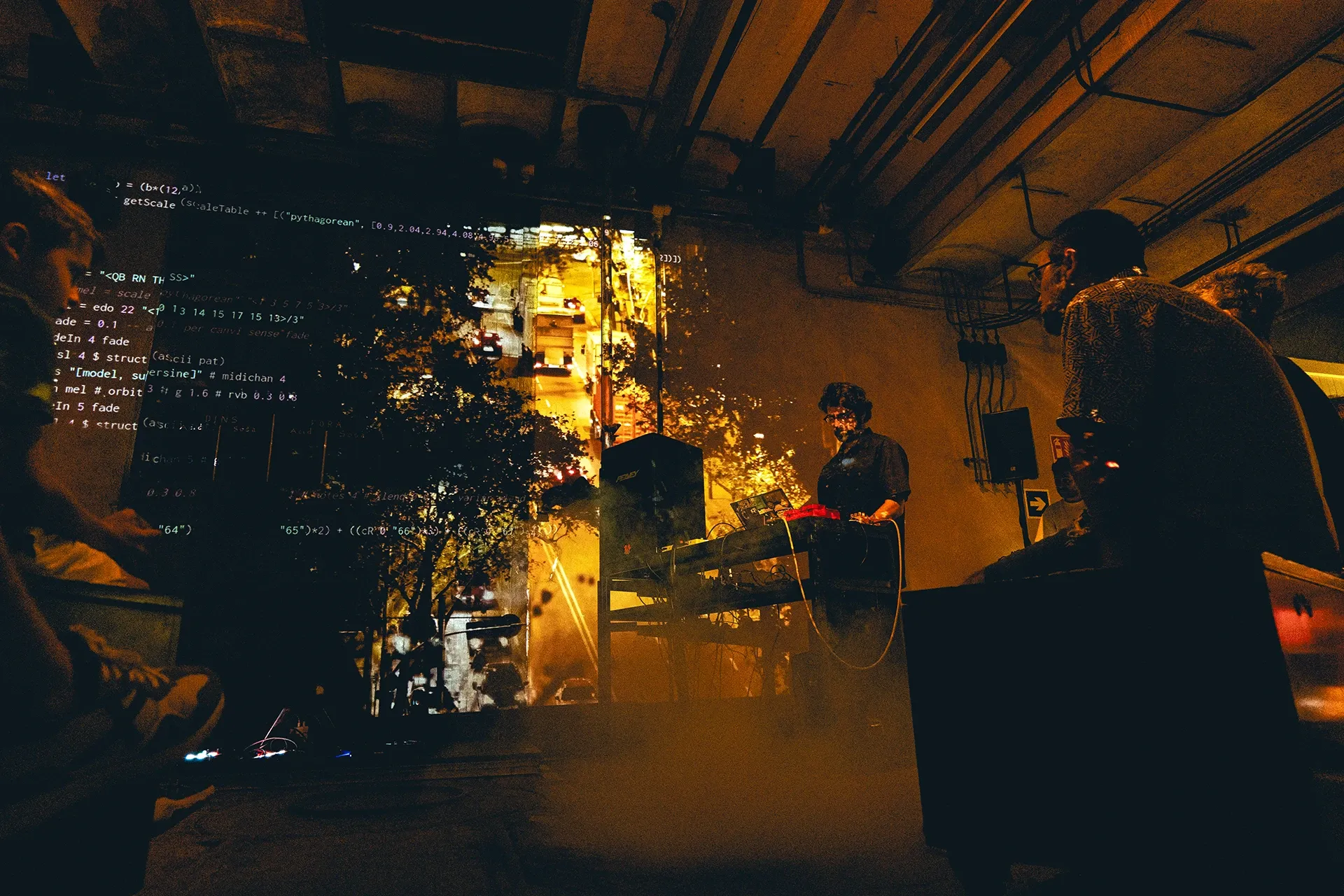
Caption: QBRNTHSS (Ramón Casamajó) – Photo: Yose Llobet
It may not be the great revolution of electronic music, but it has established itself within the artistic circuit. It has found its own space as a hybrid, complementary practice capable of bringing new perspectives to the contemporary scene.
The most festive expression of live coding is the algorave: gatherings where the dance floor feeds on real-time code, and where the community celebrates, experiments, and shares the energy of the moment. Today, almost all electronic music is made with software, but with artificial barriers between those who create algorithms and those who make music. Algoraves focus on the people who make and dance to music. The artists at these playful events take responsibility for the music they create and shape it with the tools at hand. In fact, the focus isn’t on what the artist is doing, but on the music itself and the people dancing to it. Algoraves embrace the sounds of past raves while introducing alien, futuristic rhythms and beats produced through unusual, algorithmic processes.
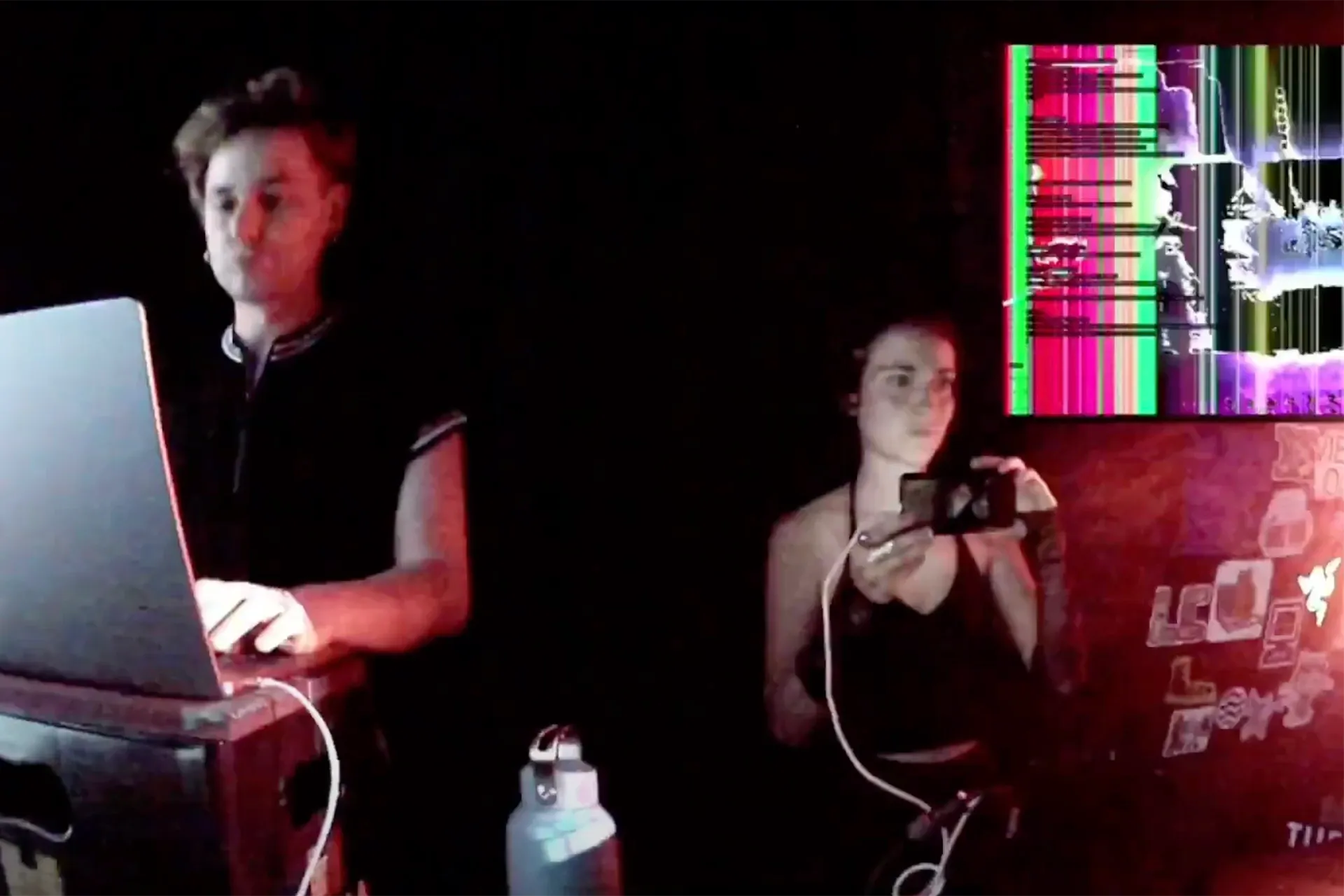
Joe Kroese and Sol Sarratea – Photo: The Generative Art Museum
Live coding emerged in the early 2000s as a creative rebellion within the world of music and digital arts. At that time, many sound and visual artists were already experimenting with computers, but the process remained hidden behind the screen. Live coding flipped the situation: “What if we show the code live, without filters, and let the audience see how the music and visuals are generated in real time?”
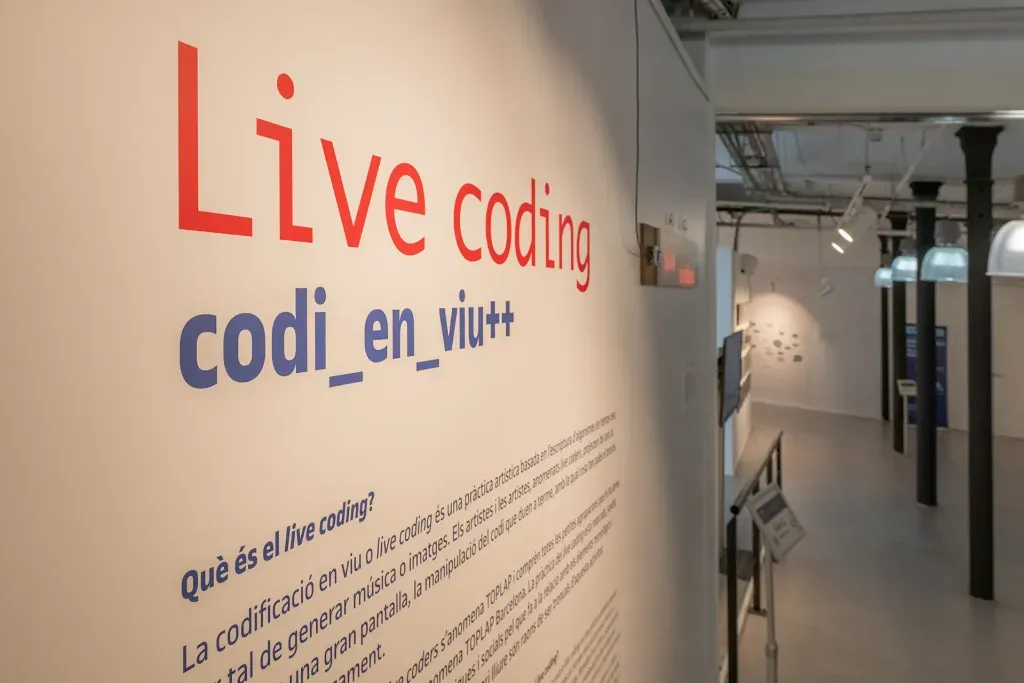 ICLC2025 – Photo: UOC
Live coding performances have also made their way to Roca Umbert Fàbrica de les Arts in Granollers, where The Generative Art Museum, in collaboration with the local collective RUSF, hosted a concert in which Ramón Casamajó (QBRNTHSS) presented a session with acoustic and electronic instruments exploring a personal space between electronic, contemporary, and experimental music. In the following concert, Turbulente (Citlali Hernández) and Eloi El Bon Noi offered a new iteration of “Ensenya’ns la pantalla” (“Show Us the Screen”), with doses of IDM and glitch where improvisation and audio-reactive visuals played a key role: the music stimulated the visuals, which responded synchronously, creating a dialogue between the two artists.
In Barcelona, there’s a vibrant community led by TOPLAP, and The Generative Art Museum is also making efforts to bring this artistic practice to a wider audience.
This article was originally written for BUMP!, the monthly newsletter on trends and digital culture in Catalonia.
Published: 2025-09-29
Author:
Xavier Hernández